Both wet pour and bonded rubber mulch are widely used, BS EN 1177 compliant safety surfaces – so when you’re trying to decide between the two, the question is rarely about which is safer. It’s about which is better suited to your space, your users, your budget and what you want the finished area to look and feel like.
This guide cuts through the noise and helps you make that call.
What Are the Two Surfaces?
Wet pour is a seamless rubber safety surface mixed and laid on site in two layers – a recycled SBR rubber base for shock absorption, topped with a coloured EPDM wearing course. It sets into a smooth, continuous surface with no joints or loose material. It’s the surface you’ll recognise from bright, colourful school playgrounds with game markings and themed designs. Find out more on our wet pour surfacing page.
Bonded rubber mulch is made from shredded recycled rubber coated in a pigmented binder and mixed with polyurethane resin. Once laid, it forms a single bonded layer that looks and feels like natural bark chippings – but with the durability and safety performance of a proper rubber surface. It’s the surface you’ll find under trim trails, in woodland play areas and community parks where a natural aesthetic matters. Find out more on our bonded rubber mulch surfacing page.
How Do They Compare?
| Wet Pour | Bonded Rubber Mulch | |
| Appearance | Smooth, seamless, brightly coloured | Natural, textured, bark-like |
| Safety standard | BS EN 1177 compliant | BS EN 1177 compliant |
| Best environments | Schools, nurseries, urban parks, splash parks, accessible routes | Woodland play, nature areas, trim trails, rural parks |
| Design flexibility | High – colours, graphics, markings, themed designs | Moderate – colour options, natural look |
| Accessibility | Fully accessible – smooth surface for wheelchairs and buggies | Good – stable bonded surface suitable for most users |
| Sub-base requirement | Requires solid base – tarmac, concrete or new compacted stone | More flexible – can work on uneven terrain or over grass |
| Maintenance | Very low | Very low |
| Lifespan | 10–15 years | 10–15 years |
| Typical cost | ~£29–39/m² excl. base works | Generally lower on suitable terrain – varies by project |
When Is Wet Pour the Better Choice?
Wet pour tends to be the stronger option when:
- Accessibility is non-negotiable. The smooth, seamless finish is ideal for wheelchair users, buggies and children with mobility needs. There is no texture variation or unevenness across the surface.
- Design is part of the brief. If the playground needs to be colourful, educational or themed – number trails, game markings, animal shapes, school branding – wet pour is far more flexible.
- The space sees heavy daily footfall. Schools and nurseries with hundreds of children using a play area every day benefit from the durability and low ongoing maintenance of a well-installed wet pour surface.
- There is already a solid base. If you are replacing an existing tarmac or concrete surface, wet pour can be laid directly on top, which keeps preparation costs down.
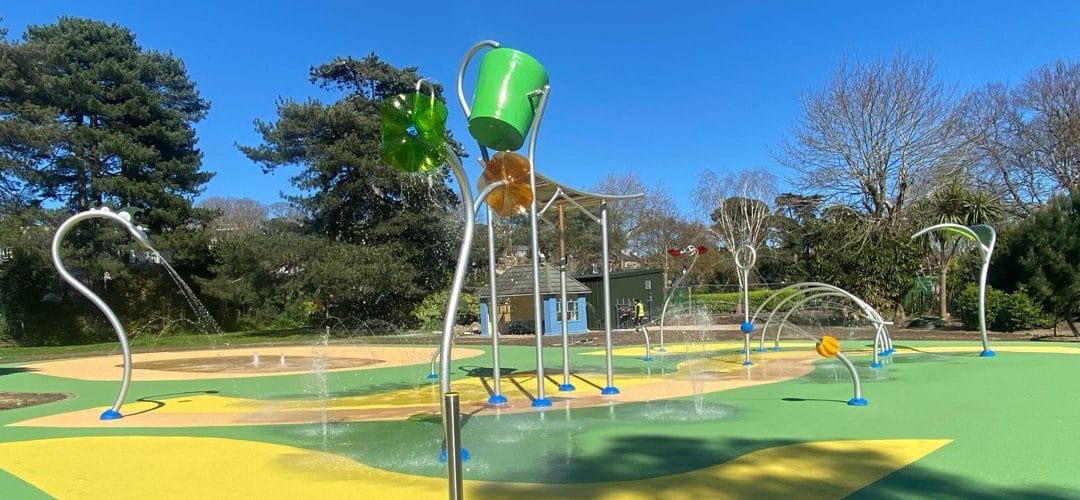
- It is a splash park or water play area. Wet pour is the standard choice for splash parks due to its seamless, porous, non-slip finish.
When Is Rubber Mulch the Better Choice?
Bonded rubber mulch tends to make more sense when:
- A natural aesthetic is important. In parks, woodland play areas and outdoor learning environments, the bark-like appearance of rubber mulch integrates far more naturally into the surroundings than a brightly coloured rubber surface would.
- The terrain is uneven or there is no existing hard base. Rubber mulch is more forgiving on difficult ground. It can be installed over grass or compacted earth with appropriate preparation, which can reduce groundwork costs significantly.
- The project involves a trim trail or nature play equipment. These settings almost always call for a more organic look, and rubber mulch delivers that while still meeting the required fall height standards.
- Budget is a constraint. On suitable terrain, rubber mulch installations can come in at a lower overall cost, particularly where extensive base works would otherwise be required for wet pour.
What About Cost?
Both surfaces vary considerably in price depending on the size of the area, the depth required for fall height compliance, the condition of the existing ground and the complexity of the design.
Wet pour typically costs in the region of £29–39 per square metre for a standard installation, excluding base preparation works. Bonded rubber mulch can be more cost-effective on suitable terrain, particularly where the flexibility of the installation reduces the need for significant groundwork. On sites that require substantial base preparation either way, the cost difference between the two narrows considerably.
The most reliable way to understand what your project will cost is to have a site survey carried out. Abacus offers free site surveys across the UK – get in touch to arrange one.
Which Surface Is Right for You?
If your project is a school playground, nursery, splash park or any space where accessibility, vibrant design and heavy daily use are the priority – wet pour is almost certainly the right choice.
If your project is a nature play area, woodland trail, community park or any space where a natural aesthetic and flexible installation conditions matter more – bonded rubber mulch is likely the better fit.
If you are still unsure, the honest answer is that both are excellent surfaces and the right call depends on the specifics of your site. Abacus installs both across the UK and can advise on which is most appropriate once we have seen the project. For a deeper technical comparison of both surfaces, see our detailed guide to choosing between wet pour and rubber mulch.
Ready to Discuss Your Project?
Abacus Playgrounds installs both wet pour and bonded rubber mulch surfacing across the UK, working with schools, councils, contractors and landscape architects. We offer free site surveys and can advise on the most appropriate surface for your specific project with no obligation. Get in touch to arrange a visit.
Frequently Asked Questions
What is bonded rubber mulch? Bonded rubber mulch is a safety surface made from shredded recycled rubber bound together with a polyurethane resin. Once laid, it forms a stable, porous, bark-like surface that meets BS EN 1177 impact attenuation standards for playground use. It is widely used in parks, woodland play areas and nature-themed playgrounds.
What are the drawbacks of rubber mulch? The main considerations are aesthetic limitations compared to wet pour – rubber mulch does not lend itself to colourful graphics, game markings or themed designs. It also requires appropriate site preparation to ensure consistent depth and drainage. It is not ideal for very young children or crawling infants due to the textured surface.
Is wet pour or rubber mulch cheaper? This depends on the project. Wet pour typically costs around £29–39 per m², excluding base works. Rubber mulch can be more cost-effective on sites where the flexible installation reduces groundwork requirements. On sites requiring full base preparation, regardless, costs are more comparable. A site survey is the most reliable way to get an accurate comparison for your specific project.
Which surface is better for young children? Wet pour is generally preferred for very young children and nursery-age play areas. The smooth, seamless finish is easier to crawl and walk on, fully accessible for buggies, and easier to keep clean. Bonded rubber mulch is better suited to older children and mixed-age outdoor environments.
Can rubber mulch be installed without a hard base? Yes, in many cases. Bonded rubber mulch is more flexible than wet pour in terms of sub-base requirements and can be installed over compacted earth or grass with appropriate preparation. Your site conditions will determine the exact specification – a site survey will confirm the most appropriate approach.