Choosing the right safety surface for a playground or outdoor space is not a decision to make lightly. The material beneath play equipment determines how well children are protected from falls, how accessible the space is for all users, how much ongoing maintenance is required, and how the area performs over years of heavy use.
Wetpour rubber surfacing has become one of the most widely specified safety surfaces in the UK – installed across schools, nurseries, council parks, splash parks and community spaces every day. When specified correctly and installed to the right depth, it performs consistently for a decade or more. This guide covers what wetpour is, how it is made, what installation involves, what it costs, and how to decide whether it is the right surface for your project.
What Is Wetpour Surfacing?
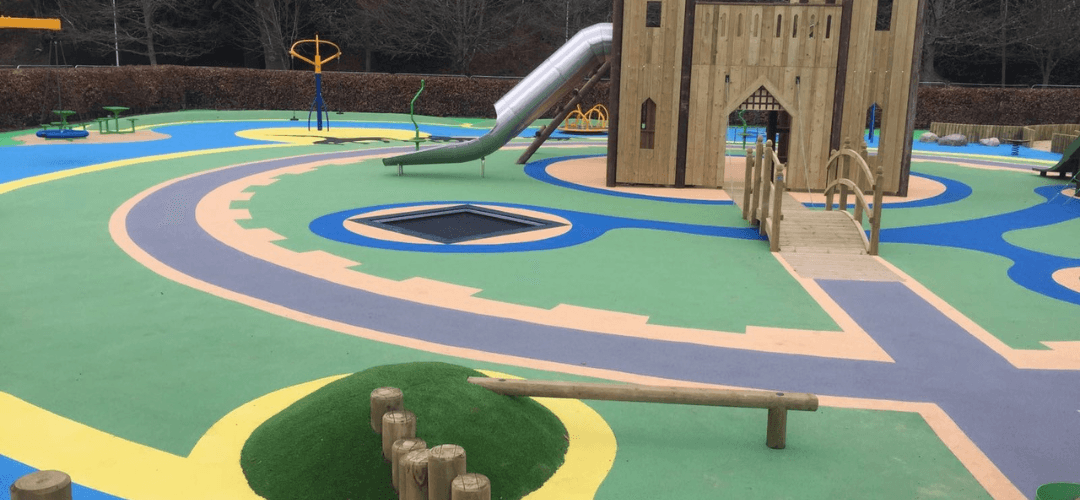
Wetpour rubber surfacing is a seamless, impact-absorbing safety surface made from rubber granules bound together with a polyurethane resin. Unlike loose-fill options such as bark or gravel, wetpour is mixed and poured on site, setting into a smooth, continuous surface with no joints, no loose material and no trip hazards.
It handles heavy daily use well, drains freely in wet weather, and provides consistent underfoot cushioning across its entire area. It is used across a wide range of outdoor settings – from primary school playgrounds and nursery areas to council parks, splash zones, outdoor fitness areas and multi-use games areas. For full details on our installation service, visit our wet pour surfacing page.
How Is Wetpour Made? The Two-Layer System
Every wetpour installation consists of two distinct layers, each serving a different purpose.
The base layer – SBR rubber
The lower layer is made from SBR (Styrene Butadiene Rubber) granules, typically produced from recycled vehicle tyres, mixed with a polyurethane binder and laid to the required depth. Its job is structural: absorbing the energy from a fall before it reaches the ground. The SBR base is almost always black.
The top layer – EPDM rubber
Above the SBR base sits a wearing course made from EPDM (Ethylene Propylene Diene Monomer) granules – a synthetic rubber with excellent resistance to UV degradation and weathering, which is why wetpour retains its colour and texture outdoors over many years. The EPDM layer provides the non-slip, accessible finish that users interact with directly, and it is available in a wide range of colours, from standard primaries to custom blends, playground graphics and bespoke themed designs.
Where Can Wetpour Be Installed?
Wetpour can be laid over most solid existing surfaces, including tarmac and concrete, or onto a new compacted sub-base where no existing hard surface is present. A site assessment will determine the appropriate base specification for your project.
Common applications include school playgrounds and nursery areas, council-managed parks, splash parks and water play zones, outdoor fitness areas, multi-use games zones, accessible pathways and sensory gardens. The seamless, porous finish makes it particularly well suited to spaces that need to be fully accessible – providing a stable, level surface for wheelchair users and buggies without the displacement associated with loose-fill materials.
Critical Fall Height – What It Means and What Depth You Need
Any safety surface installed beneath play equipment in the UK must be specified in accordance with BS EN 1177 – the standard governing impact-attenuating playground surfacing. The key concept is Critical Fall Height (CFH): the maximum height from which a child could fall without the impact causing a serious head injury, based on the shock-absorbing properties of the surface.
In practical terms, the required depth of your wetpour installation is determined by the height of the equipment above it. Getting this right is not just a regulatory requirement – it directly determines how effectively children are protected.
Abacus specifies all installations to meet BS EN 1177 and provides full fall-height guidance before any work begins. The table below shows the relationship between wetpour depth and critical fall height:
| Wetpour Depth (mm) | Critical Fall Height (m) |
| 30mm | 1.26m |
| 40mm | 1.36m |
| 50mm | 1.65m |
| 60mm | 2.04m |
| 70mm | 2.24m |
| 80mm | 2.47m |
| 90mm | 2.60m |
| 100mm | 2.62m |
| 120mm | 2.82m |
| 140mm | 3.00m |
A single play area often contains multiple pieces of equipment at different heights, each requiring its own fall zone and depth. For a detailed breakdown across different surface types, see our full guide to playground surfacing depths.
How Much Does Wetpour Surfacing Cost in the UK?
Wetpour surfacing costs vary considerably depending on project specifics. A common benchmark in the UK market is roughly £29–39 per square metre for a standard installation, excluding base preparation. Projects involving bespoke graphics, multi-colour layouts or significant groundwork will sit higher.
The main factors that affect the final cost:
- Area size – larger projects reduce the cost per m² due to economies of scale
- Depth – greater installation depth means more material and higher cost
- Colour and design – single-colour finishes are most cost-effective; custom graphics and multi-colour layouts add cost
- Sub-base condition – an existing solid surface reduces preparation costs; new base works add to the overall budget
- Location and access – travel costs and site access conditions vary across the UK
The most reliable way to understand project cost is a site survey and written specification. Abacus offers free site surveys across the UK – get in touch to arrange one.
How Is Wetpour Installed?
Wetpour is a professional installation – mixed and poured on site using specialist equipment – and the quality of the finished surface depends significantly on ground preparation and the experience of the team carrying out the work.
A standard Abacus installation follows this process:
- Site assessment and specification – we visit the site, measure the area, assess ground conditions, identify equipment fall heights and prepare a full specification including depth, colour and edge details
- Sub-base preparation – the existing surface is checked for stability, drainage and levels; new base works are carried out where required
- SBR base layer – recycled SBR rubber granules are mixed with polyurethane binder on site and laid to the specified depth
- EPDM top layer – the coloured wearing course is mixed and applied; where multiple colours or graphics are included these are laid in sequence
- Curing and handover – wetpour requires 24–48 hours to cure fully; most installations are complete and ready to use within a few days
Find out more about our wet pour installation service.
How Long Does Wetpour Last?
When professionally installed on a sound base and given routine maintenance, wetpour typically lasts between 10 and 15 years. Lifespan is influenced by the volume of daily use, sub-base quality, UV exposure and maintenance regime.
Wetpour does not need to be replaced in its entirety if localised wear or damage occurs. Patch repairs using matching EPDM granules can extend the effective life of a surface considerably, and full overlays are possible where the base remains structurally sound but the surface needs refreshing.
How Do You Maintain Wetpour Surfacing?
Wetpour requires relatively little routine maintenance – no infill to top up, no loose material to redistribute.
Routine cleaning – clear leaves and debris regularly with a stiff brush or leaf blower, and pressure wash periodically to prevent build-up that can reduce drainage performance.
Moss and algae – shaded or damp areas are more susceptible. A mild cleaning solution applied when growth first appears is far more effective than leaving it to establish.
Checking for damage – small cracks, lifted edges or areas of shrinkage are worth addressing promptly. Minor repairs caught early are straightforward and inexpensive; left unattended they can develop into more significant issues.
For a full maintenance guide see our wetpour care and maintenance page. Abacus also offers professional cleaning, repair and rejuvenation services for existing surfaces.
Is Wetpour the Right Surface for Your Project?
Wetpour is a strong choice for most school, nursery, park and community play environments – particularly where accessibility, design flexibility and long-term durability are priorities. It works especially well where equipment involves significant fall heights, a clean modern aesthetic is preferred, or colourful and themed designs are part of the brief.
For natural or woodland-themed play areas, bonded rubber mulch often makes more sense aesthetically while delivering the same safety performance. For a full comparison of both surfaces, see our guide to choosing between wet pour and rubber mulch.
Ready to Discuss Your Project?
Abacus Playgrounds has been installing wetpour rubber surfacing across the UK for more than 20 years, working with schools, councils, contractors and landscape architects on projects of all sizes. We offer free site surveys and tailored specifications with no obligation. Visit our wet pour surfacing page for more information, or get in touch to arrange a site visit.
Frequently Asked Questions
How long does wetpour surfacing last? When professionally installed and properly maintained, wetpour typically lasts between 10 and 15 years, depending on usage levels, sub-base quality and maintenance routine.
How much does wetpour surfacing cost per m² in the UK? A standard installation typically costs in the region of £29–39 per m², excluding base preparation. Final cost depends on area size, required depth, colour specification and site conditions. Contact us for a free site survey and accurate quotation.
Can wetpour be repaired if it gets damaged? Yes. Localised patch repairs using matching EPDM granules are straightforward and cost-effective. Full overlays are also available, and Abacus supplies DIY repair kits for minor damage.
What is the difference between SBR and EPDM in wetpour surfacing? SBR forms the base layer – providing the structural depth and shock absorption required for fall height compliance. EPDM is the coloured wearing course on top, giving the non-slip, UV-resistant finish that users walk and play on.
Does wetpour need planning permission? In most cases, no. Wetpour is typically installed as a surface replacement and does not require planning permission. If your project involves significant groundworks or a protected site, it is worth checking with your local authority – our team can advise on this during the site survey.
How long does wetpour take to dry after installation? Wetpour generally requires 24–48 hours to cure fully before use, depending on temperature and humidity.