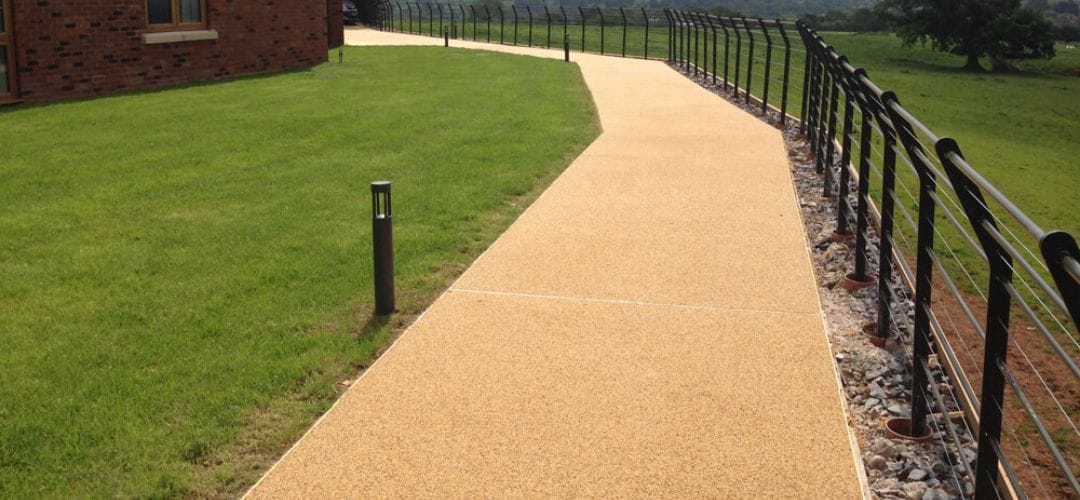
For schools, councils and developers specifying outdoor paths, entrances and communal areas, resin-bound gravel has become one of the most practical and widely used surfacing options in the UK. It combines natural stone aggregate with a clear resin to create a smooth, permeable surface that is durable, low maintenance and visually adaptable to almost any setting.
This guide covers what resin bound surfacing is, where it works best, what it costs, and how to choose colours – written specifically for the schools, public sector organisations and developers that make up the majority of Abacus’s clients rather than for the residential driveway market that dominates most content on this topic.
What Is Resin Bound Surfacing?
Resin bound surfacing is made by mixing natural stone aggregates – granite, quartz, flint or marble – with a clear, UV-stable polyurethane resin. The mixture is trowel-applied on site over a prepared base, creating a smooth, seamless surface that is fully permeable. Water passes through the surface rather than running off it, making resin bound one of the few surfacing options that is inherently compliant with Sustainable Urban Drainage System (SuDS) regulations.
It is worth distinguishing resin bound from resin bonded surfacing, as the two are often confused. With resin bonded, resin is applied to the base first and aggregate scattered on top – the result is not permeable and aggregate can shed over time. Resin bound mixes the two components together before laying, creating a far more durable and consistent finish. For the pathways, school grounds, parks and public spaces that Abacus installs, resin bound is almost always the correct specification.
For full product details, visit our resin bound gravel surfacing page.
What Are the Benefits of Resin Bound Surfacing?
Permeability and SuDS compliance
The most significant practical advantage of resin bound surfacing is that it allows rainwater to drain directly through it rather than pooling on the surface or running off into drainage systems. This makes it compliant with SuDS requirements – increasingly a planning condition on new developments – and reduces the risk of surface flooding, puddles and the associated slip hazards. For councils and developers working on sites where drainage is a consideration, this is often the deciding factor.
Long lifespan with minimal maintenance
A professionally installed resin bound surface typically lasts between 15 and 25 years. Because the aggregate is fully bound within the resin rather than sitting loose on top, there is no material to displace, scatter or sweep back. The surface resists weed growth and is easy to clean with a pressure wash. For schools and councils managing large sites, this translates directly into lower long-term maintenance costs compared with gravel, tarmac or block paving alternatives.
Accessibility
The smooth, even finish is suitable for wheelchair users, buggies and pushchairs and meets DDA accessibility standards. Unlike loose gravel, there is no risk of the surface shifting or creating uneven areas over time. This makes resin bound a practical choice for school entrances, public footpaths and any route where accessibility is a requirement.
Safety
The textured surface of natural aggregate provides grip in wet conditions, reducing slip risk compared with smooth concrete or tarmac. It is particularly well suited to pathways in parks, school grounds and communal areas used throughout the year in all weathers.
Aesthetics and design flexibility
Resin bound surfaces are available in a wide range of aggregate colours and can be customised with borders, patterns and colour blends to suit the surrounding environment or incorporate branding. The natural stone appearance integrates well with landscaping – far more so than tarmac or concrete – while the UV-stable resin maintains colour consistency without fading or chalking over time.
Where Is Resin Bound Surfacing Used?
Resin bound gravel is a versatile material suited to a wide range of outdoor settings beyond the residential driveways that most content on this topic focuses on. For Abacus, the most common applications are:
Schools and educational settings – entrances, pathways, communal areas and the routes connecting play zones. Resin bound is not typically used directly under playground equipment – wetpour and rubber mulch serve that purpose – but works well for the surrounding paths, access routes and borders that complete a playground project.
Public parks and council-managed spaces – footpaths, recreational areas and tree surrounds. The natural aggregate appearance suits park environments well, and the permeability supports drainage across larger open sites.
Housing developments and communal areas – shared pathways, courtyard surfaces and estate routes where a durable, low-maintenance finish is required. Developers increasingly specify resin bound for the kerb appeal it adds alongside its practical performance.
Healthcare and education campuses – accessible routes and pedestrian areas where a smooth, accessible, low-maintenance surface is needed across large sites.
Visitor attractions, heritage sites and golf clubs – locations where the natural appearance of stone aggregate needs to complement the surrounding landscape without the visual intrusion of tarmac or concrete.
For a detailed specification guide covering sub-bases, edging and aggregate selection for pathways, see our resin bound gravel specification and design guide.
Resin Bound Colours and Finishes
One of the most practical advantages of resin bound surfacing is the breadth of colour and aggregate options available. Abacus installs Daltex aggregates, which offer a wide palette of natural stone colours and blends:
Natural and neutral tones – Golden Quartz, Autumn Quartz, Somerset Quartz, Pearl Quartz, Devon Yellow and Rhinegold. These are widely used in parks, heritage settings and school grounds where an understated, natural appearance is the priority.
Warmer tones – Amber Gold, Brittany Bronze, Staffordshire Pink and Golden Pea. Popular for housing developments, entrance areas and communal spaces where a warm, welcoming aesthetic is wanted.
Contemporary and bold options – Silver, Arctic White, White Flint, Black, Red and Green. Used for demarcation lines, borders, corporate branding and settings where a distinctive finish is part of the design brief.
Colour combinations can be mixed to create borders, transition zones or pattern elements within a single installation. Corporate logos, school crests and branded graphics can also be incorporated into the resin surface – a useful option for school entrances and commercial reception areas. Colour samples are available on request, and Abacus can advise on which aggregates work best for specific environments and uses.
How Much Does Resin Bound Surfacing Cost?
Resin bound surfacing typically costs between £45 and £80 per square metre, though the final cost depends significantly on project specifics. Unlike tarmac or concrete, resin bound involves specialist mixing and installation on site, and the aggregate and resin materials vary in price depending on what is specified.
The main factors affecting cost are:
- Area size – larger projects reduce the per-m² cost due to material and labour efficiencies
- Aggregate choice – premium stone such as granite or quartz costs more than standard mixes
- Sub-base condition – an existing sound tarmac or concrete base can often be used directly, reducing preparation costs; sites requiring excavation or new base construction add to the overall budget
- Design complexity – borders, patterns, colour blends and logos increase material and labour time
- Location and access – travel, delivery and site access conditions affect overall project cost
Compared with tarmac or block paving, resin bound typically has a higher upfront installation cost. However, the long lifespan (15–25 years) and minimal maintenance requirements mean the total cost over the life of a surface is often lower – a relevant consideration for schools and councils managing budgets over the long term.
The most reliable way to understand project cost is a site survey and written specification. Abacus offers free site surveys across the UK – get in touch to arrange one.
Resin Bound vs Resin Bonded – What Is the Difference?
This is one of the most common points of confusion when specifying resin surfacing. The two systems are fundamentally different in how they are constructed and how they perform.
Resin bound: aggregate and resin are mixed together before being trowel-applied to the prepared base. The result is a fully permeable, seamless surface where aggregate is locked within the resin matrix. It does not shed, crack or displace under normal use.
Resin bonded: resin is applied to the base as a layer and aggregate is then broadcast on top. The surface is not permeable and, over time, aggregate can loosen and shed from the surface. It is generally not suitable for high-footfall public or educational settings.
For schools, councils, developers and landscape architects, resin bound is almost always the appropriate specification. For a broader comparison of resin bound against traditional surfacing alternatives, see our resin bound vs traditional paving guide.
How Is Resin Bound Surfacing Installed?
Resin bound surfacing requires specialist equipment and trained installers – the quality of the finished surface depends entirely on correct mixing ratios, base preparation and application technique. A standard Abacus installation follows this process:
- Site assessment – base condition, drainage, levels and edging requirements are assessed
- Base preparation – existing tarmac or concrete is cleaned and checked for structural integrity; new base works are carried out where required
- Edging installation – aluminium, steel or concrete edging is fixed around the perimeter to contain the surface and define boundaries
- Mixing and laying – aggregate and resin are mixed on site using a forced-action mixer to ensure even coating, then trowel-applied to the prepared base at the correct depth (typically 15–18mm)
- Curing – the surface is generally walkable within 4–6 hours and fully cured within 24 hours
Poorly installed resin bound surfacing can delaminate, craze or drain inconsistently – all of which are expensive to remedy. Professional installation by an experienced team is essential for a result that performs as intended over its full lifespan.
Ready to Discuss Your Project?
Abacus Playgrounds installs resin bound gravel surfacing across the UK for schools, councils, developers and landscape architects. We offer free site surveys and can advise on aggregate selection, sub-base specification and design options for your project. Visit our resin bound gravel surfacing page for more information, or get in touch to arrange a site visit.
Frequently Asked Questions
What is the difference between resin bound and resin bonded? Resin bound mixes aggregate and resin together before laying, creating a fully permeable, durable surface where aggregate is locked in place. Resin bonded applies resin first and scatters aggregate on top – it is not permeable and can shed aggregate over time. For high-footfall public and educational settings, resin bound is almost always the correct specification.
Is resin bound gravel permeable? Yes. Because the aggregate is fully coated and bound within the resin matrix, water passes through the surface freely rather than running off. This makes resin bound SuDS compliant and suitable for sites where surface water management is a planning or environmental consideration.
How long does resin bound surfacing last? When professionally installed on a sound base, resin bound surfacing typically lasts between 15 and 25 years. Lifespan depends on sub-base quality, usage levels and whether the surface receives any routine maintenance such as occasional pressure washing.
How much does resin bound surfacing cost per m²? A typical installation costs between £45 and £80 per m², depending on area size, aggregate choice, sub-base condition and design specification. A free site survey is the most reliable way to get an accurate cost for your specific project.
Can resin bound surfacing be installed over existing tarmac or concrete? Yes, in most cases. Existing tarmac or concrete can serve as the base provided it is structurally sound, level and draining correctly. A site assessment will confirm whether the existing surface is suitable or whether preparation works are required.