Most school leaders are working with the same constraints: outdoor space that never feels quite big enough, a PE curriculum that demands more than one or two dedicated pitches can deliver, and budgets that require every investment to earn its keep across years, not months.
A MUGA – Multi-Use Games Area – is one of the most practical responses to all three. Done well, it turns a single outdoor space into a year-round, all-weather sports facility that serves the whole school. This guide covers what a MUGA is, what it can do for your school, what surfacing options are available, and what to expect in terms of cost and funding.
What Is a MUGA?
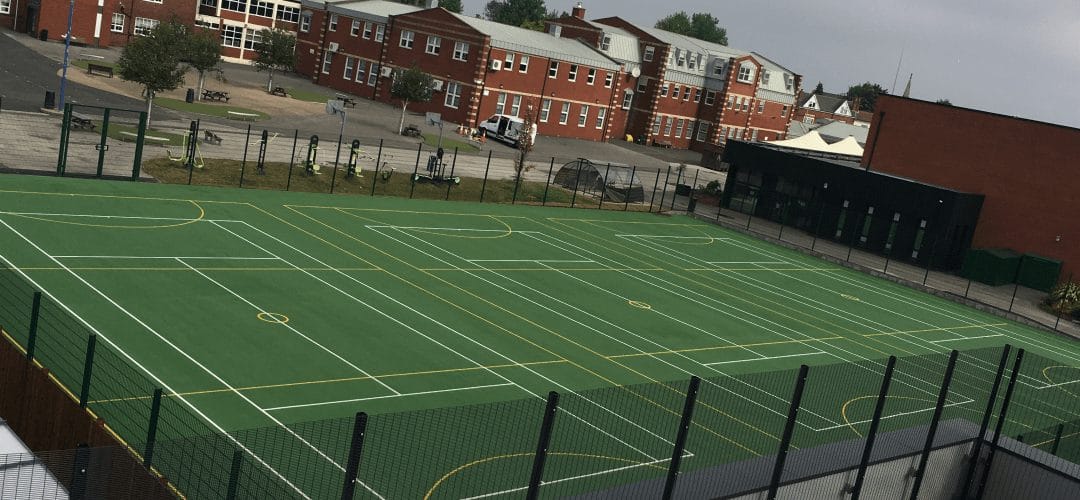
MUGA stands for Multi-Use Games Area. It is a purpose-built, enclosed outdoor sports surface designed to accommodate multiple sports within a single space. A school MUGA typically features multi-sport line markings for games such as football, netball, basketball, tennis and hockey, with perimeter fencing to keep balls in play and define the playing area.
The surface is installed to an all-weather specification – polymeric rubber, macadam or synthetic turf – making it usable year-round regardless of weather conditions. Surface type, pitch size and fencing specification are all tailored to the school’s available space, curriculum requirements and budget. Find out more about our MUGA surfacing options.
What Sports Can a School MUGA Accommodate?
The defining characteristic of a MUGA is that line markings for multiple sports co-exist on a single surface, colour-coded to distinguish each sport clearly. A well-designed school MUGA can typically support football, netball, basketball, tennis, hockey and tag rugby.
The combination of markings is tailored to your school’s curriculum and the age range of your pupils. A primary school might prioritise tag rugby, mini tennis and playground games; a secondary school might lean towards five-a-side football, basketball and athletics. The pitch is designed around how you actually intend to use it.
How Does a MUGA Benefit a School?
More children are active, more often
Only 47% of children in England are currently meeting the recommended 60 minutes of daily physical activity, according to Sport England’s Active Lives survey. An all-weather MUGA eliminates one of the most common barriers to that activity: outdoor PE lessons and break times disrupted by wet weather, waterlogged fields or unusable outdoor spaces. A MUGA is usable 365 days a year, in all conditions.
A broader PE curriculum in one space
A single football pitch locks a school into one sport. A MUGA with multiple markings allows PE staff to deliver football, netball, basketball and tennis in the same week, using the same space. Children who don’t connect with one sport get exposure to others – which matters both for participation rates and for identifying talent across a wider range of activities.
Positive impact on behaviour and wellbeing
Physical activity during break and lunchtime has a well-established effect on concentration and behaviour in the afternoon. Schools that give pupils structured, appealing spaces to be active during unstructured time consistently report improvements in classroom focus. A properly marked, enclosed MUGA gives children a reason to get moving rather than standing around.
Year-round use without the maintenance of natural grass
Natural grass pitches require resting, reseeding and closure during wet periods. A MUGA surface requires none of that. It performs consistently throughout the year, needs minimal upkeep, and does not deteriorate with heavy use in the way that grass does. For schools where outdoor space is precious, having a surface that is always available is a significant practical advantage.
Income generation outside school hours
A MUGA earns its cost over time, not just through curriculum use but through hire. Local football clubs, community sports groups, fitness instructors and after-school programme providers will often pay to use a well-maintained, floodlit MUGA during evenings and weekends. For many schools, this becomes a meaningful revenue stream – the kind of long-term income that makes the initial investment considerably easier to justify.
Inclusivity and accessibility
The right surface choice makes a MUGA accessible to children with a range of physical needs. Polymeric rubber surfaces in particular, meet accessibility standards and provide a consistent, even surface that supports children with mobility difficulties alongside their peers. An enclosed, defined space also makes supervision easier for staff managing mixed-ability groups.
What Surface Types Are Available for School MUGAs?
Surface choice is one of the most important decisions in any MUGA project. The right surface depends on the primary sports the MUGA will be used for, the expected intensity of use, and the available budget.
Polymeric rubber A durable, porous rubber surface providing excellent shock absorption. Well suited to basketball, netball and multi-sport use where a firm, even surface with good grip is the priority. Low maintenance, all-weather, and meeting accessibility standards. Abacus installs polymeric rubber MUGA surfaces across the UK – visit our multi-use games areas page for full details.
Macadam (tarmac-based) The most widely installed MUGA surface. Macadam is hard-wearing, cost-effective and performs reliably for tennis, five-a-side football and general multi-sport use. It requires minimal maintenance and has a long lifespan, making it the natural choice where budget is a primary consideration alongside durability.
Synthetic turf (2G or 3G) Artificial grass surfaces provide a more natural feel underfoot and are often preferred for football and hockey. 2G surfaces are sand-based and suited to a range of sports; 3G surfaces have a longer pile and are particularly popular for football-focused MUGAs. Synthetic turf requires more maintenance than rubber or macadam – regular brushing and occasional infill top-up – but delivers a playing experience closer to natural grass. Abacus also installs artificial grass surfaces for school environments.
How Much Does a School MUGA Cost?
MUGA costs vary significantly depending on pitch size, surface type, fencing specification, groundworks required and whether lighting is included. As a general guide, a school MUGA installation typically costs between £40,000 and £120,000, with smaller primary school installations at the lower end of that range and larger or more complex secondary school projects at the higher end.
The factors that most influence cost are:
- Pitch size – the most significant single variable
- Surface type – synthetic turf typically costs more than macadam or polymeric rubber
- Fencing height and specification – standard 1.8m fencing costs less than taller rebound panels
- Groundworks and drainage – sites requiring excavation or significant ground preparation add to the overall budget
- Floodlighting – extends usability and hire potential but adds to installation cost
- Line marking configuration – worth specifying carefully upfront to avoid changes later
The most reliable way to understand what your project will cost is to have a site survey carried out. Abacus offers free site surveys across the UK and can provide a full specification and quotation based on your site and requirements. Get in touch to arrange one.
Can Schools Use PE and Sports Premium Funding for a MUGA?
Yes, in many cases – though eligibility depends on how the investment is framed. Primary schools in England receive over £16,000 annually through the PE and Sport Premium, and a MUGA can qualify as eligible spending where it creates sustainable, long-term improvement in physical activity provision rather than a one-off capital purchase.
To make a MUGA eligible for Sports Premium funding, schools typically need to demonstrate that it will improve PE curriculum delivery, increase pupil participation in sport over the long term, and generate measurable impact on physical activity outcomes. A MUGA with a structured PE plan and an after-hours hire programme is considerably easier to justify than one without.
It is worth checking the current Sport Premium guidance and speaking to your local authority before committing funding. Our funding page has further information, and Abacus can advise on the kinds of planning and evidence that tend to support successful applications as part of the early project discussion.
Ready to Discuss Your MUGA Project?
Abacus Playgrounds installs MUGA surfaces across the UK, working with primary schools, secondary schools, councils and community organisations on projects of all sizes. We offer free site surveys and can advise on the right surface specification, size and budget for your school. Visit our multi-use games areas page for more information, or get in touch to arrange a site visit.
Frequently Asked Questions
What does MUGA stand for? MUGA stands for Multi-Use Games Area – a purpose-built outdoor sports surface designed to accommodate multiple sports within a single, enclosed space.
What is a MUGA at school? A school MUGA is an all-weather outdoor pitch with multi-sport line markings and perimeter fencing. It allows a school to deliver a range of sports – football, netball, basketball, tennis and hockey, among others – using a single surface, making the most of limited outdoor space and budget.
How much does a MUGA pitch cost? A typical school MUGA installation costs between £40,000 and £120,000 depending on pitch size, surface type, fencing specification and site conditions. A free site survey is the most reliable way to get an accurate cost for your specific project.
What sports can be played on a school MUGA? A MUGA can be marked for football, netball, basketball, tennis, hockey, tag rugby and more. The combination of markings is tailored to the school’s curriculum, age range and available space.
Can Sports Premium funding be used for a MUGA? In many cases yes, provided the MUGA is framed as a sustainable, long-term investment in PE provision rather than a capital purchase. Schools should check current Sport Premium eligibility criteria and seek advice on how to structure the application. Abacus can support this conversation as part of the project planning process.